
Portrait of a Learner
In May 2026, the California State Board of Education adopted a Portrait of a Learner, including a preamble and aspirational competencies, intended to guide decision-making.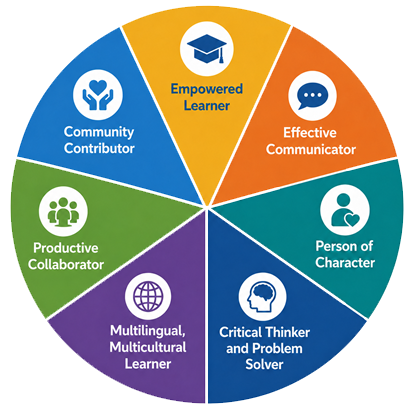
Preamble
The State Board of Education (SBE) has adopted a Portrait of a Learner that is intended to help the state more clearly define and support the knowledge, skills, and experiences students need to thrive in college, career, and civic life.
Developed with valuable input from community partners, the SBE’s Portrait of a Learner synthesizes the Board’s ongoing priorities and sharpens its policy focus moving forward with structured considerations of where students are going, what they will need, and how the Board can build a system that will help them get there.
It is important to note that the SBE’s Portrait of a Learner aims to support a vision that can support evaluation and alignment of the Board’s work; it is not a new initiative or a mandate, but a unifying framework intended to act as a north star to guide the SBE’s decision-making. The Portrait of a Learner provides a framework that can be used to connect curriculum, instruction, assessment, and student supports around a common purpose. It also centers student experience, emphasizing that all students should have access to engaging, relevant learning opportunities that foster both academic knowledge and durable skills.
Many local educational agencies and schools have created their own portraits of a learner or graduate that they use for these and other purposes. There is no expectation that local educational agencies change their local portraits or use the SBE’s tool. Local educational agencies and schools are invited to consider the SBE’s Portrait of a Learner to the extent that it is useful to them in their work.
Competencies
The SBE’s Portrait of a Learner includes the following competencies, which are not ranked by importance or presented in any particular order.
- Empowered Learner — Demonstrates mastery and application of academic competencies. Understands how to learn independently and with others, taking initiative and adapting to change with flexibility. Embraces challenge and perseveres through difficulty, able to grow through effort and reflection, while drawing on personal strengths and goals to navigate school, career, and life.
- Critical Thinker and Problem Solver — Builds on a strong academic foundation to ask critical questions, carefully analyze information, and develop creative solutions to complex challenges using imagination and problem-solving skills. Develops financial, environmental, data, and digital literacies, including AI literacy, to evaluate information and make informed decisions in a rapidly changing world.
- Effective Communicator — Listens carefully and communicates clearly, purposefully and creatively through speaking, writing, visual media, the arts, and technology. Engages diverse audiences with intention, adapting communication to context, purpose, and audience needs.
- Multilingual, Multicultural Learner — Develops proficiency in multiple languages while deepening understanding and appreciation of diverse cultures and expanding the ability to connect across communities.
- Person of Character — Acts with honesty, kindness, empathy, compassion, and care for others. Attends to own well-being, enabling self-care. Demonstrates strong character by treating others with fairness, dignity, and respect, and by valuing varied perspectives through understanding of others’ feelings, needs, and experiences.
- Productive Collaborator — Collaborates effectively with others to reach shared goals by building positive relationships, actively listening to and understanding diverse perspectives, and contributing to the efforts of the group. Demonstrates leadership by both taking initiative and enabling others to do so, drawing on the strengths of each to accomplish larger goals.
- Community Contributor — Contributes to the common good through active, informed engagement in civic affairs, recognizing rights and responsibilities, and improving the welfare of others by attending to the needs of people and their shared environments. Participates in democratic processes and takes positive action to support the health, environmental sustainability, and well-being of communities and ecosystems, locally and globally.