
California Department of Education Logo

Joaquin Moraga Intermediate


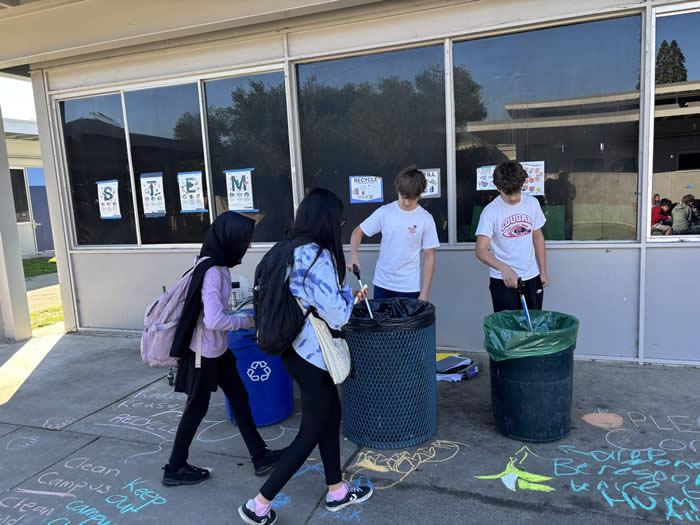
Students participating in sorting waste at their school trash cans.

Joaquin Moraga Intermediate School (JMIS) exemplifies environmental leadership and sustainability in action. Serving a diverse student body in the Moraga–Walnut Creek Watersheds, JMIS integrates sustainability across academics, operations, and community engagement, distinguishing itself through rigorous environmental literacy standards, Collaborative for High Performance Schools (CHPS)/Leadership in Energy and Environmental Design (LEED)-aligned facilities, and innovative programs such as Jan Term capstone projects that connect Science, Technology, Engineering, and Mathematics (STEM), civic action, and sustainability. The school fosters deep community collaboration, leveraging multi-stakeholder groups, professional development partnerships, and local agencies to provide hands-on, place-based learning—from creek restorations to biodiversity monitoring and waste-reduction campaigns—while engaging students as active environmental leaders. Sustainability is embedded as a lived experience through outdoor classrooms, edible gardens, renewable-energy projects, and civic engagement programs spanning all grade levels. Students gain practical knowledge in energy, climate, and ecological systems, while participating in service projects that strengthen community resilience and environmental stewardship. Through its comprehensive approach to curriculum, operations, and civic partnership, JMIS cultivates environmentally literate, socially responsible, and community-conscious students prepared to advance long-term sustainability and lead in a changing world.

Questions:   George Garcia | GREENRIBBONSCHOOLS@cde.ca.gov | 916-322-2470
Last Reviewed: Wednesday, February 11, 2026
Recently Posted in School Facilities
  • The Guide to Long-Range Facilities Master Plans (updated 10-Nov-2026)
    The Guide to Long-Range Facilities Master Plans (LRFMP) was revised in 2026, with updated guidance on master planning for local educational agencies and Proposition 2 requirements for school districts applying for School Facility Program Funding.
  • Key Components of a Facilities Master Plan (added 10-Nov-2026)
    The elements of a typical facilities master plan (FMP) and guidance on what to include, how to organize the information, and why it matters, from the Guide to Long-Range Facilities Master Plans.
  • Conclusion (added 10-Nov-2026)
    A summary on master plans as living documents that reflect thoughtful educational goals and future planning, from the Guide to Long-Range Facilities Master Plans.
  • Education Programs with Specialized Facility Needs (added 10-Nov-2026)
    The importance of including specialized facilities in facilities master plans to meet the needs of educational programs and students with disabilities, from the Guide to Long-Range Facilities Master Plans.
  • Additional Considerations and Planning the Future (added 10-Nov-2026)
    Integrating sustainability, safety, accessibility, and climate resiliency into every stage of facilities master planning, from the Guide to Long-Range Facilities Master Plans.

  • Appendix A (added 10-Nov-2026)
    A table of Facilities Master Plan Elements vs. Proposition 2 Requirements, from the Guide to Long-Range Facilities Master Plans.
  • Appendix B (added 10-Nov-2026)
    A summary of additional required elements per Proposition 2, from the Guide to Long- Range Facilities Master Plans.
  • Facilities Master Planning Resources (added 10-Nov-2026)
    Additional resources, facilities master plan (FMP) exemplars, and links to the Office of Public School Construction (OPSC) Guidelines for the Five-Year School Facilities Master Plan, from the Guide to Long-Range Facilities Master Plans.
  • Introduction (added 10-Nov-2026)
    An introduction of the Guide to Long-Range Facilities Master Plans.
  • Facilities Master Planning Process (added 10-Nov-2026)
    Best practices for launching a facilities master planning (FMP) effort, engaging stakeholders, and long-term planning, from the Guide to Long-Range Facilities Master Plans.