
Debt Financing for California School Districts
Provides California school districts with an overview of local funding options, including bond requirements, allowable uses, bonding capacity, the school bond process, and Certificates of Participation.This section provides an overview of California school district funding options for major capital projects, including general obligation bonds and Certificates of Participation, and highlights the legal, financial, and statutory requirements that govern their use. Selecting the appropriate funding option requires careful evaluation of project needs, allowable uses, debt capacity, repayment obligations, and long-term financial impacts. Because these financing decisions involve complex legal requirements and potential risks, districts should consult with experienced legal counsel to ensure compliance, properly structure the financing, and make informed decisions that protect the district’s interests.
General Obligation Bonds Quick Facts Tables
Overview of Bond Funding and Statutory Requirements
What Are School Bonds?
Local general obligation (GO) bonds are the primary financing mechanism California school districts use to fund major capital projects that cannot be paid from annual operating budgets. GO bonds are voter-approved debt repaid through ad valorem* property taxes levied by the county which allow districts to borrow money upfront and repay the debt over time.
*An ad valorem property tax is a tax based on the assessed value of real property (such as homes, commercial buildings, and land). The higher the property's assessed value, the more property tax the owner pays. Therefore, the county repays the school district's GO bonds by collecting a property tax that is proportional to each property's assessed value.
Bond repayment typically ranges from 25–30 years depending on the issuance structure, and is generally designed to align with the expected useful life of the project.
What Can Bond Funds Be Used For?
Bond proceeds are generally used for:
- New school construction
- Modernization and renovation of existing facilities
- Classroom additions and campus expansions
- Health and safety improvements
- Technology infrastructure and permanent educational equipment (under Proposition 39)
- Acquisition of school sites and real property
What Bond Funds Cannot Be Used For
California law prohibits bond proceeds from being used for:
- Teacher and staff salaries
- Routine maintenance and operations
- Utility costs
- General operating expenses
Key Constitutional and Statutory Authorities
Prop. 39 bond elections are subject to specified statutory election dates, generally aligned with statewide primary or general elections. Prop. 46 bond elections may have greater flexibility, including the ability to be called as a special election.
Proposition 46 (1986)
- Requires two-thirds (66.67 percent) voter approval
- Permits school districts to issue GO bonds supported by ad valorem property taxes
- Funds may be used primarily for acquisition or improvement of real property
- Does not generally permit furniture, vehicles, or movable equipment*
Proposition 39 (2000)
- Reduced voter approval threshold of 55 percent
- Allows bond proceeds to be used for:
- Construction
- Reconstruction
- Rehabilitation
- Replacement of facilities
- Furnishing and equipping school facilities
- Requires additional accountability measures:
- Citizens' Bond Oversight Committee
- Annual financial audits
- Annual performance audits
Accountability Requirements Under Proposition 39
Districts must:
- Establish a Citizens' Bond Oversight Committee within 60 days of certification of election results. (See California Education Code (EC) sections 15278-15282)
- Conduct annual independent financial audits.
- Conduct annual performance audits.
- Ensure bond proceeds are spent only on projects described in the ballot measure.
How to Determine District Bonding Capacity
Understanding Bonding Capacity
Bonding Capacity refers to the maximum amount of GO debt a district may legally have outstanding.
California law establishes statutory debt limits based on assessed valuation (AV).
Specified Tax Cap: Set by EC sections 15102,15106,15268, and 15270
Statutory Debt Limits
| District Type | Maximum Debt Ratio |
|---|---|
| Unified School District | 2.5 percent of AV |
| Elementary School District | 1.25 percent of AV |
| High School District | 1.25 percent of AV |
Example Formula for Bonding Capacity
Unified School District
Bonding Capacity = Assessed Valuation × 2.5 percent
Elementary/High School District
Bonding Capacity = Assessed Valuation × 1.25 percent
A school district should consult with their legal counsel, county assessor and municipal advisor to determine bonding capacity.
Additional Proposition 39 Tax Rate Limits
Before issuing bonds, districts must demonstrate they can remain within statutory tax-rate limits:
| District Type | Maximum Tax Rate |
|---|---|
| Unified School District | $60 per $100,000 AV |
| Elementary School District | $30 per $100,000 AV |
| High School District | $30 per $100,000 AV |
Therefore, bonding capacity is often constrained by:
- Legal debt limit
- Tax rate limit
- Assessed value growth projections
- Existing debt obligations
Source: B.1.3.1 Local General Obligation Bonds – California Debt Financing Guide

School Bond Prcess
While this section provides a general overview of the school bond process, school legal counsel should be consulted before beginning the school bond process.
Phase 1 – Needs Assessment
District leadership identifies facility and infrastructure needs:
- Aging facilities
- Enrollment growth
- Modernization requirements
- Technology upgrades
- Health and safety improvements
- Educational program needs
Phase 2 – Facilities Planning and Cost Estimation
The district develops:
- Facilities Master Plan
- Technology Master Plan
- Project scope
- Cost estimates
- Prioritized project lists
Phase 3 – Community Engagement
Districts provide information regarding:
- Facility needs
- Project benefits
- Expected tax rates
- Accountability measures
- Polling (to see if there’s community interest in approving a bond)
Phase 4 – Board Authorization
The Governing Board:
- Reviews capital needs
- Adopts a resolution calling for an election
- Establishes proposed bond amount
- Approves ballot language
Phase 5 – Voter Approval
Election requirements:
| Authorization Type | Approval Threshold |
|---|---|
| Proposition 46 | 66.67 percent |
| Proposition 39 | 55 percent |
Phase 6 – Bond Sale
Following voter approval:
- Bond counsel prepares legal documents
- Financial advisor develops issuance strategy
- Credit ratings are obtained
- Bonds are sold through:
- Competitive Sale or
- Negotiated Sale
Phase 7 – Construction and Program Delivery
Funds are used for approved projects such as:
- New campuses
- Classroom modernization
- HVAC replacement
- Roofing projects
- Technology infrastructure
- Safety/security upgrades
Phase 8 – Oversight and Reporting
Districts conduct:
- Annual financial audits
- Annual performance audits
- Citizens' Oversight Committee reporting
- Board and public reporting
Phase 9 – Debt Repayment
Property taxes collected by the County are used to:
- Repay principal
- Pay interest
- Meet debt service obligations
Bond repayment typically ranges from 25–30 years depending on the issuance structure.
Certificates of Participation (COPs)
What Are Certificates of Participation?
COPs are a common form of lease financing used by school districts to fund facility and capital improvement projects without voter approval.
Rather than borrowing money through a traditional loan or voter-approved general obligation (GO) bond, a district enters into a lease financing arrangement. Investors purchase certificates representing a share of the lease payments made by the district, and those payments are used to repay investors over time.
In COP financing:
- A trustee bank structures and administers the transaction.
- Investors purchase interests in the lease payments.
- The district makes annual lease payments.
- Lease payments are distributed to investors through the trustee.
Because COPs are sold in the tax-exempt municipal market, school districts often obtain lower borrowing costs than they would through conventional equipment leases or bank financing, particularly for large capital projects.
Why School Districts Use COPs
Key Advantages
- No voter approval required
- Unlike GO bonds, COPs can be authorized by the Governing Board without a public election.
- Access to capital more quickly
- Lower interest rates for large projects
- Because COPs are sold in the tax-exempt municipal market, they often provide lower borrowing costs than traditional lease financing.
- Flexible Financing Tool
COPs provide a faster financing option when:
- Urgent facility needs exist
- Bond elections are not feasible
- Interim financing is needed pending future funding
COPs can finance:
- School construction projects
- Facility modernization
- Site acquisitions
- Relocatable classrooms
- School buses
- Computers and technology equipment
- Refinancing of existing leases
- Interim financing before GO bond issuance or State facility funding
Typical Uses of COP Financing
School Facilities
- New classroom buildings
- Multipurpose rooms
- Gymnasiums
- Administrative facilities
- Site improvements
Modernization Projects
- Heating, ventilation, and air conditioning (HVAC) replacement
- Roofing
- Electrical upgrades
- Plumbing improvements
- Safety and security projects
Capital Equipment
- Portable classrooms
- School buses
- Technology devices
- District-wide infrastructure systems
Interim Financing
Many districts use COPs as a bridge financing tool while waiting for:
- School Facility Program funds
- Future GO bond sales
- Developer fee collections
- Other capital revenues
Key Rules and Considerations
The COP repayment term generally cannot exceed the useful life of the project being financed.
Examples:
| Asset | Typical Useful Life |
|---|---|
| School Building | 30–40 years |
| HVAC System | 15–20 years |
| Portable Classroom | 15–25 years |
| Computers | 3–7 years |
Cannot Fund Operations
COPs may not be used for:
- Salaries
- Benefits
- General operating costs
- Instructional programs
- Routine district operations
COPs must finance long-term capital assets.
General Fund Obligation
Unlike GO bonds, which are repaid through dedicated property taxes, COPs are typically secured by the district's General Fund.
The district pledges to:
- Appropriate funds annually
- Budget sufficient payments each year
- Make lease payments through the duration of the financing
This is often referred to as an annual appropriation pledge.
Impact on State Hardship Eligibility
An important California consideration is that:
- COP debt is generally considered debt when evaluating State hardship funding eligibility.
- Traditional leases generally are not considered debt for this purpose.
Districts should analyze potential impacts on future State school facility funding applications.
COP Financing Structure
Simplified Transaction Flow
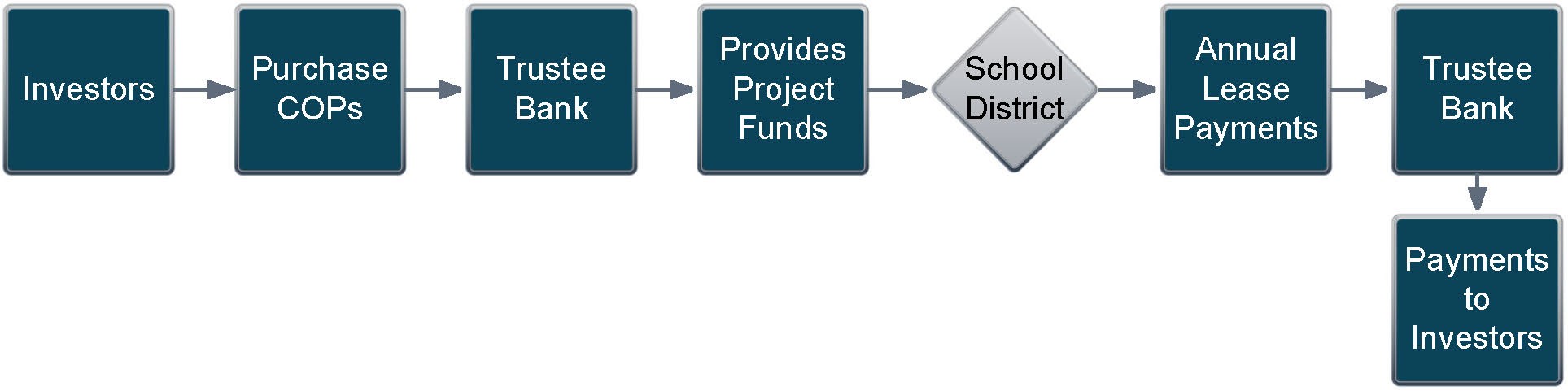
The trustee serves as the intermediary between the district and investors.
COP Issuance Process
Step 1 – Identify Capital Need
District identifies:
- Construction projects
- Facility improvements
- Equipment purchases
- Refinancing opportunities
Step 2 – Financial Analysis
District financial advisors evaluate:
- Debt capacity
- Repayment affordability
- General Fund impact
- Market conditions
Step 3 – Board Approval
- Unlike GO bonds, voter approval is not required.
- The Governing Board authorizes the financing and approves legal documentation.
Step 4 – Preparation of Financing Documents
- Legal and financing teams prepare transaction documents.
Step 5 – Market and Sell COPs
- The financing is offered to investors in the municipal bond market.
Step 6 – Receive Project Proceeds
- District receives funds for approved capital projects.
Step 7 – Annual Lease Payments
- The district budgets and makes lease payments until the financing is fully repaid.
Major COP Documents
The Governing Board typically approves the following legal documents:
Preliminary Official Statement (POS)
Provides investors with information regarding:
- District finances
- Project description
- Repayment security
- Risks associated with the financing
Final Official Statement (OS)
The final disclosure document distributed to investors.
Lease Agreement
Defines:
- Property being leased
- Payment schedule
- Financing terms
Ground Lease
Transfers leasehold interest in district property used as collateral for the financing structure.
Trust Agreement
Establishes the trustee's responsibilities.
Assignment Agreement
Assigns lease payment rights to the trustee for the benefit of investors.
Continuing Disclosure Certificate
Requires ongoing financial reporting and disclosure to investors throughout the life of the financing.
Local General Obligation Bonds at a Glance
Purpose
Fund major capital improvements and school facility projects.
Repayment Source
Voter-approved property taxes.
Voter Thresholds
- Proposition 46: 66.67 percent
- Proposition 39: 55 percent
Bonding Capacity
| District Type | Debt Limit |
|---|---|
| Unified School District | 2.5 percent of assessed valuation (AV) |
| Elementary School District | 1.25 percent of AV |
| High School District | 1.25 percent of AV |
| Community College | 2.5 percent of AV |
Proposition 39 Tax Rate Limits
| District Type | Maximum Tax Rate |
|---|---|
| Unified | $60/$100,000 AV |
| Elementary | $30/$100,000 AV |
| High School | $30/$100,000 AV |
| Community College | $25/$100,000 AV |
Allowable Uses
- New construction
- Modernization and renovation
- Safety improvements
- Classroom additions
- Technology infrastructure
- Furniture and equipment (Prop 39 – check with legal counsel for specific guidance)
Not Allowable
- Salaries
- Operating expenses
- Routine maintenance
- Utilities
Required Accountability Measures
- Citizens' Oversight Committee
- Annual Performance Audit
- Annual Financial Audit
Typical Bond Term
- 25 years (Education Code authority)
- Up to 40 years (Government Code authority)
Key Takeaway
A district's ability to issue bonds depends on three key factors:
- Voter authorization (55 percent or 2/3 approval)
- Statutory debt limit based on assessed valuation
- Ability to keep projected tax rates within Proposition 39 limits while repaying debt
School bonds provide districts with the long-term financing necessary to build, modernize, and equip school facilities while spreading repayment across future taxpayers who benefit from the infrastructure.