
California Department of Education Logo

St. Martin of Tours Academy

This page contains information on St. Martin of Tours Academy the 2022 Green Ribbon Selectee.
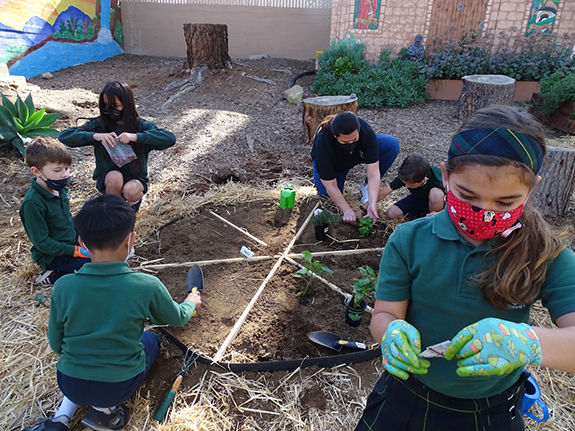
Picture of 2nd graders prepare the Pizza Garden for herbs and veggies.

In 2015, St. Martin of Tours Academy (SMA) became the first Catholic elementary school in the nation to be declared a Fair-Trade School by Fair-Trade Campaigns. Through the Fair-Trade curriculum, the whole school community learns how Fair-Trade practices support small farmers and artisans who make or grow products in developing countries in an environmentally sustainable way. SMA has an increased focus on reduced water use due to California’s drought. The school has replaced landscaping with drought-tolerant plants, rocks, and mulch throughout the property. SMA’s Sustainable Practices Policy has eliminated single-use plastic and Styrofoam. At SMA, bins are placed in the two courtyards to collect organic waste, which is placed in the three-bin compost system to complete the composting cycle. Students learn how to sustain an organic garden, which provides many opportunities for community outreach as well as environmental and life science curriculum goals. The science curriculum blends hands-on investigations, literacy-rich activities, and interactive digital tools to empower students to think, read, write, and argue like scientists and engineers.

Application External link opens in new window or tab. (PDF)

Questions:   California Green Ribbon Schools | GREENRIBBONSCHOOLS@cde.ca.gov | 916-322-2470
Last Reviewed: Wednesday, May 28, 2025
Recently Posted in School Facilities
  • The Guide to Long-Range Facilities Master Plans (updated 10-Nov-2026)
    The Guide to Long-Range Facilities Master Plans (LRFMP) was revised in 2026, with updated guidance on master planning for local educational agencies and Proposition 2 requirements for school districts applying for School Facility Program Funding.
  • Key Components of a Facilities Master Plan (added 10-Nov-2026)
    The elements of a typical facilities master plan (FMP) and guidance on what to include, how to organize the information, and why it matters, from the Guide to Long-Range Facilities Master Plans.
  • Conclusion (added 10-Nov-2026)
    A summary on master plans as living documents that reflect thoughtful educational goals and future planning, from the Guide to Long-Range Facilities Master Plans.
  • Education Programs with Specialized Facility Needs (added 10-Nov-2026)
    The importance of including specialized facilities in facilities master plans to meet the needs of educational programs and students with disabilities, from the Guide to Long-Range Facilities Master Plans.
  • Additional Considerations and Planning the Future (added 10-Nov-2026)
    Integrating sustainability, safety, accessibility, and climate resiliency into every stage of facilities master planning, from the Guide to Long-Range Facilities Master Plans.

  • Appendix A (added 10-Nov-2026)
    A table of Facilities Master Plan Elements vs. Proposition 2 Requirements, from the Guide to Long-Range Facilities Master Plans.
  • Appendix B (added 10-Nov-2026)
    A summary of additional required elements per Proposition 2, from the Guide to Long- Range Facilities Master Plans.
  • Facilities Master Planning Resources (added 10-Nov-2026)
    Additional resources, facilities master plan (FMP) exemplars, and links to the Office of Public School Construction (OPSC) Guidelines for the Five-Year School Facilities Master Plan, from the Guide to Long-Range Facilities Master Plans.
  • Introduction (added 10-Nov-2026)
    An introduction of the Guide to Long-Range Facilities Master Plans.
  • Facilities Master Planning Process (added 10-Nov-2026)
    Best practices for launching a facilities master planning (FMP) effort, engaging stakeholders, and long-term planning, from the Guide to Long-Range Facilities Master Plans.