
California Department of Education Logo

National School District (NSD)


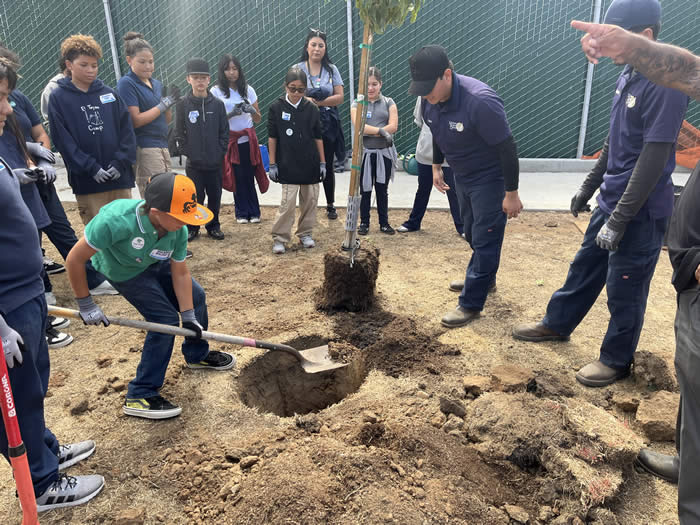
Students participating in tree planting.

National School District (NSD) exemplifies how high-impact sustainability can thrive in high-need communities, serving 90% low-income, English learner, foster, or homeless students, and 95% Latinx/Filipino students. Over the past decade, the district has achieved measurable gains—including over 1 million gallons of annual water savings, 1,000+ tons of waste diverted, a 13% reduction in Green House Gass (GHG) emissions, and improved energy efficiency—through comprehensive operational upgrades, student-led initiatives, and School Design Guide (SDG)-aligned projects. NSD leverages robust partnerships with organizations such as Rady Children’s Hospital, Olivewood Gardens, Ocean Connectors, and Tree San Diego, and engages families and the community to embed sustainability into daily life. Its multi-year strategy integrates resource conservation, health, and environmental literacy into operations and curricula, preparing students as future environmental leaders. Recognized through California Green Ribbon (Silver 2024, Gold 2025), America’s Healthiest Schools (90% of schools), and other awards, NSD demonstrates that sustainability, academic excellence, and community engagement can flourish in high-need districts, creating a lasting culture of environmental stewardship.

Questions:   George Garcia | GREENRIBBONSCHOOLS@cde.ca.gov | 916-322-2470
Last Reviewed: Wednesday, February 11, 2026
Recently Posted in School Facilities
  • The Guide to Long-Range Facilities Master Plans (updated 10-Nov-2026)
    The Guide to Long-Range Facilities Master Plans (LRFMP) was revised in 2026, with updated guidance on master planning for local educational agencies and Proposition 2 requirements for school districts applying for School Facility Program Funding.
  • Key Components of a Facilities Master Plan (added 10-Nov-2026)
    The elements of a typical facilities master plan (FMP) and guidance on what to include, how to organize the information, and why it matters, from the Guide to Long-Range Facilities Master Plans.
  • Conclusion (added 10-Nov-2026)
    A summary on master plans as living documents that reflect thoughtful educational goals and future planning, from the Guide to Long-Range Facilities Master Plans.
  • Education Programs with Specialized Facility Needs (added 10-Nov-2026)
    The importance of including specialized facilities in facilities master plans to meet the needs of educational programs and students with disabilities, from the Guide to Long-Range Facilities Master Plans.
  • Additional Considerations and Planning the Future (added 10-Nov-2026)
    Integrating sustainability, safety, accessibility, and climate resiliency into every stage of facilities master planning, from the Guide to Long-Range Facilities Master Plans.

  • Appendix A (added 10-Nov-2026)
    A table of Facilities Master Plan Elements vs. Proposition 2 Requirements, from the Guide to Long-Range Facilities Master Plans.
  • Appendix B (added 10-Nov-2026)
    A summary of additional required elements per Proposition 2, from the Guide to Long- Range Facilities Master Plans.
  • Facilities Master Planning Resources (added 10-Nov-2026)
    Additional resources, facilities master plan (FMP) exemplars, and links to the Office of Public School Construction (OPSC) Guidelines for the Five-Year School Facilities Master Plan, from the Guide to Long-Range Facilities Master Plans.
  • Introduction (added 10-Nov-2026)
    An introduction of the Guide to Long-Range Facilities Master Plans.
  • Facilities Master Planning Process (added 10-Nov-2026)
    Best practices for launching a facilities master planning (FMP) effort, engaging stakeholders, and long-term planning, from the Guide to Long-Range Facilities Master Plans.