
California Department of Education Logo

Pacific Ridge School

This page contains information regarding Pacific Ridge School as one of the 2024 National Green Ribbon selectees.
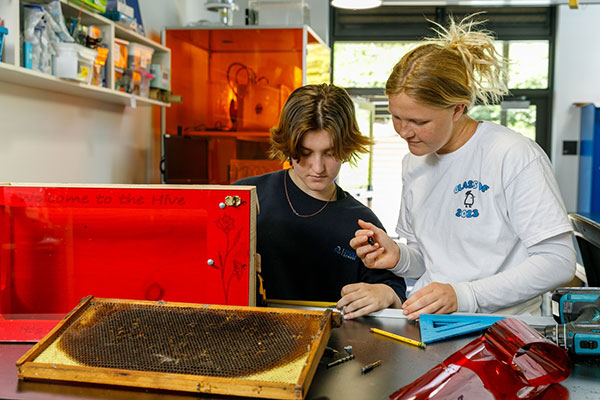
 

Two students working on a project.


Pacific Ridge students participate in service-learning projects in collaboration with local sustainability-focused organizations for beach clean-ups and wildlife conservation efforts. Moreover, the school's Global Travel program provides students with opportunities to learn about the economic dynamics, sustainable strategies of different cultures, and place-based environmental concepts. Pacific Ridge School's Upper School Urban Agriculture Club manages an organic garden, sharing its produce with the community through on-campus 'farmers markets' to raise funds supporting garden projects. The school reduces energy consumption using high-efficiency lighting and Heating, Ventilation, and Air Conditioning systems. They also use solar panels to generate 85% of the school's electricity. The school uses 100% reclaimed water for irrigation to conserve water and has adopted mulch and drip systems. They also encourage waste reduction by using reusable items, compostable serveware, and a three-bin sorting system for green waste, mixed recycling, and landfill waste.

Application External link opens in new window or tab. (PDF)

Questions:   California Green Ribbon Schools | GREENRIBBONSCHOOLS@cde.ca.gov | 916-322-2470
Last Reviewed: Tuesday, September 01, 2026
Recently Posted in School Facilities
  • The Guide to Long-Range Facilities Master Plans (updated 10-Nov-2026)
    The Guide to Long-Range Facilities Master Plans (LRFMP) was revised in 2026, with updated guidance on master planning for local educational agencies and Proposition 2 requirements for school districts applying for School Facility Program Funding.
  • Key Components of a Facilities Master Plan (added 10-Nov-2026)
    The elements of a typical facilities master plan (FMP) and guidance on what to include, how to organize the information, and why it matters, from the Guide to Long-Range Facilities Master Plans.
  • Conclusion (added 10-Nov-2026)
    A summary on master plans as living documents that reflect thoughtful educational goals and future planning, from the Guide to Long-Range Facilities Master Plans.
  • Education Programs with Specialized Facility Needs (added 10-Nov-2026)
    The importance of including specialized facilities in facilities master plans to meet the needs of educational programs and students with disabilities, from the Guide to Long-Range Facilities Master Plans.
  • Additional Considerations and Planning the Future (added 10-Nov-2026)
    Integrating sustainability, safety, accessibility, and climate resiliency into every stage of facilities master planning, from the Guide to Long-Range Facilities Master Plans.

  • Appendix A (added 10-Nov-2026)
    A table of Facilities Master Plan Elements vs. Proposition 2 Requirements, from the Guide to Long-Range Facilities Master Plans.
  • Appendix B (added 10-Nov-2026)
    A summary of additional required elements per Proposition 2, from the Guide to Long- Range Facilities Master Plans.
  • Facilities Master Planning Resources (added 10-Nov-2026)
    Additional resources, facilities master plan (FMP) exemplars, and links to the Office of Public School Construction (OPSC) Guidelines for the Five-Year School Facilities Master Plan, from the Guide to Long-Range Facilities Master Plans.
  • Introduction (added 10-Nov-2026)
    An introduction of the Guide to Long-Range Facilities Master Plans.
  • Facilities Master Planning Process (added 10-Nov-2026)
    Best practices for launching a facilities master planning (FMP) effort, engaging stakeholders, and long-term planning, from the Guide to Long-Range Facilities Master Plans.