
California Department of Education Logo

Trabuco Elementary School

This page contains information regarding Trabuco Elementary School as one of the 2024 National Green Ribbon Selectees.
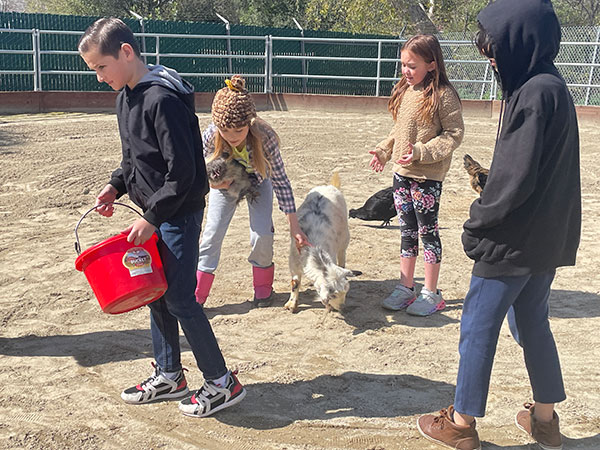
 

Four students taking care of animals.


Trabuco Elementary School (Trabuco) is in Trabuco Canyon, Orange County, surrounded by O'Neill Regional Park. The school hosts on-campus field trips, allowing schools across Orange County to partake in the school’s outdoor learning environments. The school has three gardens: a vegetable and fruit garden, a Pollinator Garden, and a Mindfulness Garden. Additionally, the school has a farm with miniature donkeys, horses, pigs, goats, sheep, and other animals. Rigorous problem-based science instruction incorporating California's Environmental Principles and Concepts extends to farm and garden lessons, fostering hands-on learning. Environmental education offers hands-on experiences with natural systems. Trabuco operates recycling and composting programs, with students sorting leftover food for landscaping or supplementing the farm animals' snacks. Trabuco Coyote Green Team, consisting of kindergarten through sixth-grade students, regularly meets to brainstorm ways to enhance campus eco-friendliness. Their initiatives have led to a 19% reduction in energy usage and a 7% decrease in water usage from the previous year.

Application External link opens in new window or tab. (PDF)

Questions:   California Green Ribbon Schools | GREENRIBBONSCHOOLS@cde.ca.gov | 916-322-2470
Last Reviewed: Tuesday, September 01, 2026
Recently Posted in School Facilities
  • The Guide to Long-Range Facilities Master Plans (updated 10-Nov-2026)
    The Guide to Long-Range Facilities Master Plans (LRFMP) was revised in 2026, with updated guidance on master planning for local educational agencies and Proposition 2 requirements for school districts applying for School Facility Program Funding.
  • Key Components of a Facilities Master Plan (added 10-Nov-2026)
    The elements of a typical facilities master plan (FMP) and guidance on what to include, how to organize the information, and why it matters, from the Guide to Long-Range Facilities Master Plans.
  • Conclusion (added 10-Nov-2026)
    A summary on master plans as living documents that reflect thoughtful educational goals and future planning, from the Guide to Long-Range Facilities Master Plans.
  • Education Programs with Specialized Facility Needs (added 10-Nov-2026)
    The importance of including specialized facilities in facilities master plans to meet the needs of educational programs and students with disabilities, from the Guide to Long-Range Facilities Master Plans.
  • Additional Considerations and Planning the Future (added 10-Nov-2026)
    Integrating sustainability, safety, accessibility, and climate resiliency into every stage of facilities master planning, from the Guide to Long-Range Facilities Master Plans.

  • Appendix A (added 10-Nov-2026)
    A table of Facilities Master Plan Elements vs. Proposition 2 Requirements, from the Guide to Long-Range Facilities Master Plans.
  • Appendix B (added 10-Nov-2026)
    A summary of additional required elements per Proposition 2, from the Guide to Long- Range Facilities Master Plans.
  • Facilities Master Planning Resources (added 10-Nov-2026)
    Additional resources, facilities master plan (FMP) exemplars, and links to the Office of Public School Construction (OPSC) Guidelines for the Five-Year School Facilities Master Plan, from the Guide to Long-Range Facilities Master Plans.
  • Introduction (added 10-Nov-2026)
    An introduction of the Guide to Long-Range Facilities Master Plans.
  • Facilities Master Planning Process (added 10-Nov-2026)
    Best practices for launching a facilities master planning (FMP) effort, engaging stakeholders, and long-term planning, from the Guide to Long-Range Facilities Master Plans.